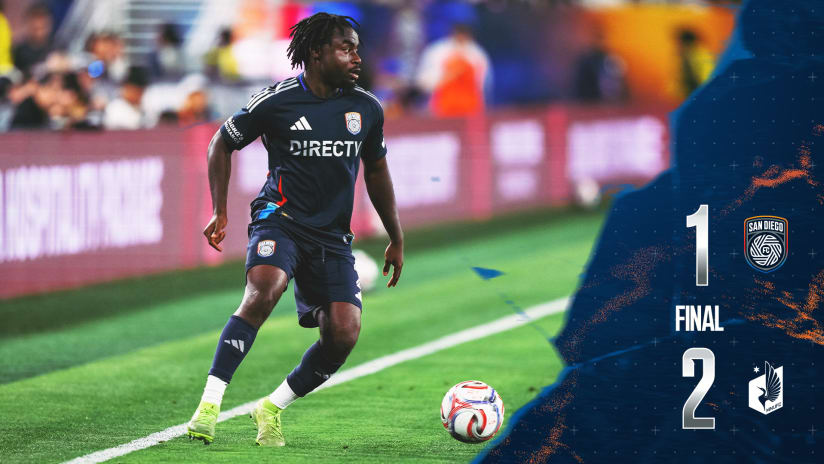
Tag: soccer

  • San Diego FC Cruise to a 5-0 Victory Against CF Montreal

    San Diego FC Cruise to a 5-0 Victory Against CF Montreal

    After a couple of Champions Cup matches, San Diego FC was back at home for their first match of the MLS regular season. Up first was CF Montreal, who had a down season in 2025. San Diego had already played a home match earlier this month with a 4-1 win against Pumas in the Champions Cup, and SDFC was looking for similar results to kick off the season on the right foot.

    Lineup

    A day before the match, MLS communications announced player availability. Notably, Wilson Eisner, who started the previous two matches in the Champions Cup, and another right back, Wily Kumado, would be out against Montreal. That meant Oscar Verhoeven could potentially start at right back, but Head Coach Mikey Varas went a different direction, starting Kieran Sargeant at left back and moving Luca Bombino to right back. Bombino has played right back before but has spent the majority of his time on the left. Another change to the starting XI was at goalkeeper, where Duran Ferree, the first-ever signee in San Diego FC history, made the start. Pablo Sisniega received a red card in the final match of the 2026 season against Vancouver, meaning he was suspended for this opener. Additionally, CJ Dos Santos did not appear to be 100% healthy after an injury in last season’s playoff match against Portland.

    Ferree is no stranger to playing in front of a San Diego crowd, as the former San Diego Loyal player represented that club in 2022 and 2023 as a teenager. When San Diego FC signed Ferree, he was loaned out to sister club FC Nordsjaelland to gain experience in the Right to Dream system. There were no other changes in the starting XI, but on the bench, there was no Lewis Morgan, who has yet to see the pitch with SDFC since being acquired from the New York Red Bulls.

    First Half

    Kicking off, San Diego was off to the races on the attack. SDFC was given a free kick within the first minute of the match, just a foot outside the penalty area. Amahl Pellegrino took the kick as a short pass to Anders Dreyer, though Dreyer muffed the kick, probably not expecting the short pass. Montreal took the ball the other way for a shot on goal a minute later, but Ferree handled the soft grounder easily at his knees. Montreal wanted to challenge the 18-year-old Ferree early by high-pressing him, but he handled himself confidently and kicked the ball away when needed. Around the 13th minute, Anders Dreyer won a corner kick and delivered it into the penalty area. Center back Chris McVey closed in and headed the ball into the back of the net. This was the second time in 2026 that the scoring started off a corner kick, following the same pattern as Manu Duah’s goal against Pumas earlier this month.

    For the rest of the half, there was a lot of back-and-forth action. Montreal did a good job in the midfield, preventing the ball from going into their final third. Chances were limited until very late in the half when Ferree passed the ball to Jeppe Tverskov, who found Manu Duah. Duah sent a long pass from his own six-yard box toward the midfield, where Marcus Ingvartsen jumped high to win an aerial battle with a defender. The ball deflected off Ingvartsen’s head to Anders Dreyer, who ran toward the Montreal goal with Amahl Pellegrino to his left. Dreyer’s shot inside the penalty area was deflected by the goalkeeper but ricocheted right to Pellegrino, who sent it into the back of the net for the second goal. The lead was 2-0 at the end of the first half, with San Diego FC holding 64% of possession, 4 shots, 3 shots on target and had completed 85% of their passes. 

    Second Half Complete Domination

    San Diego FC was fully in control, but the second half started with a scary moment as Pellegrino went down after a tackle. After a VAR check, the referee determined Tomas Aviles committed a serious foul and changed the yellow card to a straight red. Montreal was down to 10 players, giving SDFC a huge advantage. Pellegrino stayed on the pitch, and the scoring opened up again. After a Montreal throw-in, Chris McVey headed the ball before Jeppe Tverskov settled it and passed to Pellegrino. Pellegrino volleyed the ball toward Marcus Ingvartsen, who heel-passed it to Onni Valakari. Valakari dribbled closer to the penalty area and shot the ball past goalkeeper Gillier for the third goal. This was the second straight goal involvement for Ingvartsen who assisted on the goal.

    The team was far from done with a 3-0 lead. In the 59th minute, Anders Dreyer won another corner kick which went short to Pellegrino, who passed to Kieran Sargeant, then back to Dreyer. Dreyer and Pellegrino exchanged passes again to create space in front of defender Victor Louturi. Dreyer then delivered a pass inside the box to Marcus Ingvartsen, who fired a rocket inside the crossbar for another goal. The score was now 4-0. After the goal, Ingvartsen and Valakari were subbed off for Alex Mighten and David Vazquez.

    With 20 minutes left to play, it was a good time to let younger players see some action on the pitch. In the 70th minute, Pedro Soma subbed in for Anibal Godoy, and Oscar Verhoeven replaced Luca Bombino. The biggest substitution came in the 81st minute when newly signed 18-year-old Bryan Zamblé came on for Pellegrino. Zamblé  did not disappoint the fans. After SDFC won possession at midfield, David Vazquez passed to Sargeant, who found Manu Duah. Duah passed to McVey, who found Tverskov. Tverskov sent a long pass across the pitch to the near post where Zamble received it. Zamblé  sliced and diced the defender in front of him, and delivered a shot into the back of the net. That was Zamblé’s first professional goal in a 5-0 stomping where San Diego ended with 69% possession and seven shots on target.

    Huge win for San Diego FC as they cruised through Montreal for the victory. SDFC does want to repeat the success they had in 2025. Doing so will require contributions from different players and this match was a testament of the team SDFC needs to be in 2026. I am reminded of the movie Moneyball. Brad Pitt did a good job being Billy Beane and some of the principles of Moneyball holds true. When an expensive player leaves (or in the case of San Diego FC is forced out), sometimes you have to replace them in the aggregate. In this match, two different players on the left wing scored. While Pellegrino can hold the fort for now, Zamble is clearly the future of the club and will receive plenty of chances to prove himself for the starting job. We should also expect more contributions from Marcus Ingvartsen who had a pretty good game for himself.

  • Matchday Preview: CF Montréal vs. San Diego FC

    Matchday Preview: CF Montréal vs. San Diego FC

    Today we turn our attention to the club formerly known as the Montréal Impact, now competing under the banner of CF Montréal. Representing the second-largest city in Canada, Montréal is one of three Canadian teams in Major League Soccer. This Saturday’s clash at Snapdragon Stadium marks a significant milestone for San Diego FC, as they will have officially faced all three Canadian sides following this match. Although Montréal has struggled near the bottom of the standings for several seasons, San Diego FC faces their own unique set of challenges as they prepare for this home opener.

    A Legacy of Impact

    The Montréal Impact was founded in 1992 by owner Joey Saputo, who chose the name to signify a literal “impact” on the city’s sporting landscape. Before joining MLS in 2012, the club was a dominant force in the APSL and USL First Division, winning league titles in 1994, 2004, and 2009. During this successful pre-MLS era, they also secured five Commissioner’s Cups and seven Voyageurs Cups. However, since entering the top flight, consistent silverware has been more difficult to obtain. While they managed to win the Canadian Cup in 2013, 2014, 2019, and 2021, their overall league form has often been inconsistent, with only six playoff appearances since 2012. Their most recent post-season run ended in a 2024 Wild Card round loss. Over the years, the club has been led by high-profile managers such as Jesse Marsch, Thierry Henry, and Wilfried Nancy. In early 2021, the team rebranded to CF Montréal to modernize their identity into a “European-style” brand.

    In 2025

    The 2025 season was a difficult one for Montréal, as they finished 13th in the Eastern Conference and 29th overall in the league with just 28 points (6W-10D-18L). Their statistical profile reveals several critical vulnerabilities. Offensively, they ranked 28th in goals scored (34) and 25th in total shots (383) while averaging 48.7% possession. Defensively, they struggled significantly, conceding 60 goals (25th worst in the league) and allowing 171 shots on target. Their goalkeeping reflected these struggles with a save percentage of 64.9%, ranking them 26th in the league. Tactical analysis suggests they leaned heavily on a “bunker and counter-attack” style, which they utilized 32% of the time last season. Their home and away splits were particularly unusual; they were one of the league’s worst home teams with only 12 points and a league-worst 33 goals allowed, while performing slightly better on the road with 16 points and a -5 goal differential.

    Players to Watch

    Prince Owusu (Forward): Owusu remains the undisputed “shining star” of the Montréal attack. Last season, the 28-year-old German recorded career highs with 13 total goals and three assists in over 2,800 minutes. Before moving to MLS with Toronto FC—where he scored nine goals—he developed in the second and third divisions of the German Bundesliga. Now firmly settled in Montréal, Owusu recently signed a contract extension through 2027-2028. As the focal point of Montréal’s counter-attacking strategy, he will likely look to apply high pressure to San Diego’s young goalkeeper, Duran Ferree, who is set to make his first career MLS start.

    Brayan Vera (Center Back): To bolster their backline, Montréal made a significant move by trading 1.55 million in General Allocation Money (GAM) to Real Salt Lake for Brayan Vera. Vera is known for his exceptional ball security and resistance to being dispossessed, rather than high tackling or interception numbers. With over 6,000 minutes of experience at RSL and prior time in Colombia with América de Cali, Montréal is banking on the 27-year-old left-footed defender to serve as the new anchor for their defense.


    San Diego FC News: Bryan Zamblé and Roster Updates

    San Diego FC has officially confirmed the signing of 18-year-old winger Bryan Zamblé from the Right to Dream academy. Zamblé, an Ivory Coast youth international who has featured at the U-16 and U-17 levels, is signed through the 2029-2030 season and will occupy an international roster slot. After listening to head coach Mikey Varas during his media availbility, Zamblé will initially occupy the 31st roster spot as an “Unavailable” player while he acclimates to the team’s system. While this status keeps him out of primary MLS matches for now, he remains eligible for tournaments and friendlies. A clear path for his integration exists; once Leo Duru’s loan expires in June 2026, Zamblé is expected to transition into an official roster spot

  • San Diego Advances to the Round of 16

    San Diego Advances to the Round of 16

    San Diego FC played a hard-fought match on Tuesday against Pumas UNAM in Mexico City. With the aggregate score starting at 4-1 in favor of San Diego FC, the club simply needed to survive the match and avoid losing by three goals. They achieved their goal despite losing the match 1-0, moving on with a final aggregate score of 4-2. This was an impressive result considering it was only their second match of the year and they had no real preseason matches to prepare.

    The team took the pitch with the same starting eleven as the previous week, though the bench was bolstered by the return of Onni Valakari and Oscar Verhoeven alongside newcomer Bryce Duke. While the game plan was to control possession early and often, the elements of Mexico City made that strategy difficult to execute. The city sits at an elevation of 7,300 feet, and the thin air caused fatigue to set in quickly for a team accustomed to sea-level conditions. Pumas took full advantage of the environment and pressured San Diego early on, recording three shots on goal within the first 12 minutes. The third attempt by Uriel Antuna was saved by goalkeeper Pablo Sisniega, who remained very active throughout the match. At the other end of the pitch, Amhal Pellegrino missed a wide-open shot that hit the right post, representing a missed opportunity to increase the aggregate lead and put the match away early. By the end of the first half, Pumas controlled 54% of possession and led the shot count 13 to 3. Sisniega recorded three saves while the defense in front of him made 15 clearances to weather the early storm.

    Pumas opened the second half scoring in the 47th minute when Pedro Vite delivered a free kick from just outside the penalty area. The ball carried wide toward the back post and found the net, putting the match at 1-0 and the aggregate at 4-2. Needing two more goals to get ahead, Pumas stayed on the attack and dominated with 72% of the possession and 12 additional shots, six of which were on target. Sisniega was forced to save five of those on-target attempts while the SDFC backline worked tirelessly to record 29 clearances in the second half. Defensively, San Diego held their aggregate lead and did what was necessary to move on to the next round, led by Manu Duah and Jeppe Tverskov who recorded 14 and 9 clearances respectively.

    This match served as a reminder that the club is still in the very early stages of its season. There are several things to work out before the first regular-season match against C.F. Montreal. Pedro Soma started in the midfield for a second consecutive time, and while his defensive actions were decent with three recoveries, he still has more to do on the attack. In the 32nd minute, Soma attempted to take the ball downfield and pass to Anders Dreyer, but the pass went behind Dreyer, who had to struggle to receive it and get a shot off. To improve the attack, Soma needs to send those passes in stride so Dreyer has a better look at the goal. Marcus Ingvartsen was also on the pitch but was hardly noticeable on the stat sheet, finishing with just one total shot. Ingvartsen was substituted in the 65th minute, much like the previous match. Fans are likely to ask more of him in this second season, especially after an injury-riddled 2025, as he will be vital to the team’s success in 2026.

    Looking ahead, San Diego FC will face Deportivo Toluca F.C. in the Champions Cup. Toluca enters as a formidable opponent, having served as back-to-back champions of the 2025 Clausura and Apertura. The first match is scheduled for March 11th at Snapdragon Stadium, with the second leg taking place the following week in Toluca. This will be an even greater physical test for SDFC, as Toluca sits at a higher elevation than Mexico City, providing a difficult environment to face the defending Liga MX champions

    In other news, San Diego has signed Bryce Duke through the 2027 season, with club options extending through 2028-29. Duke joins from C.F. Montreal, where he spent three seasons accumulating over 4,600 minutes, six goals, and seven assists across all competitions. His professional journey also includes stints with Inter Miami’s senior and Inter Miami 2, the Las Vegas Lights, and both LAFC and LAFC 2. Last season, the 23-year-old was limited to just over 700 minutes and a single assist for Montreal, likely due to an injury that sidelined him for a couple of months. Much like Lewis Morgan, Duke is a player the front office hopes will rediscover his 2024 form, a season in which he played over 2,200 minutes and contributed three goals and four assists. Duke is known for excellent ball distribution, notably completing 67% of his long passes in 2024. Because San Diego FC’s system requires contributors on both sides of the ball, his reputation as a solid defender makes him a good fit. While his shooting has room for improvement—he recorded only 34 shots with an xG of 2.44 in 2024—it remains to be seen how his skill set will flourish within the SDFC system.

  • SDFC Takes a Commanding 4-1 Win and What to Expect in Match 2 Against Pumas

    SDFC Takes a Commanding 4-1 Win and What to Expect in Match 2 Against Pumas

    While the Super Bowl often dominates the national conversation, it is time to refocus on San Diego FC’s next match. Following a commanding 4-1 victory over Pumas last week, the club is in an excellent position to advance in the CONCACAF Champions Cup. If the team maintains the level of play they displayed in that first leg, moving on to the next round should be a straightforward task.

    Starting Lineup

    The starting lineup for the previous match featured Pablo Sisniega in goal, as CJ Dos Santos likely continues his recovery from a head injury sustained late last season. The defensive line included Wilson Eisner making his club debut at right back, while the midfield was anchored by Pedro Soma, Jeppe Tverskov, and Anibal Godoy. Onni Valakari was a notable absence from the main squad, as he has been training individually while recovering from a hamstring injury. The attacking front was led by Amahl Pellegrino, Marcus Ingvartsen, and Anders Dreyer. Lewis Morgan was not on the bench for this match

    First Half: Dominance Despite a Deficit

    San Diego FC appeared to have control from the opening whistle, yet they found themselves down 1-0 in the 11th minute after a spectacular bicycle kick by Robert Morales—arguably one of the greatest goals ever scored at Snapdragon Stadium. Despite the early deficit, the first half was a statistical showcase for SDFC, as they maintained 72% possession and a 90% passing completion rate. While they struggled to convert their 0.59 xG into goals before the break, they dominated the flow of the game with eight total shots.

    Second Half: The Offensive Explosion

    The momentum shifted dramatically in the second half when the team turned on the jets following tactical substitutions. In the 63rd minute, Alex Mighten and David Vazquez entered the match, providing an immediate spark. Mighten quickly forced a corner, which Anders Dreyer delivered perfectly for Manu Duah to header home the equalizer. This opened the floodgates for an incredible 18-minute stretch where David Vazquez, Alex Mighten, and Luca Bombino all found the back of the net to seal the 4-1 win. Anders Dreyer was a key playmaker throughout the surge, contributing secondary assists on three of the four goals. It was a particularly promising performance from the younger players, who proved they could handle significant roles under pressure.

    Tactical Shift: The Power of the Cross

    A fascinating tactical shift emerged as SDFC heavily prioritized crosses into the penalty area, a strategy that was successful. The team recorded 38 crosses in the match—the highest total since their 2025 home opener against St. Louis City. This is a notable departure from their 2025 form, where they ranked 17th in the league for crosses, and suggests a new strategy for breaking down low-block defenses. Wilson Eisner’s performance at right back was a major factor in this success; the former San Jose Earthquake, acquired through waivers, is proving to be a valuable minor league free agent addition to the squad.

    Looking Ahead to Mexico City

    As the series moves to Mexico City, San Diego FC holds a comfortable three-goal aggregate lead. Pumas, are coming off a hard-fought 2-2 draw against Atlas on Saturday night. Given that many of their starters played in both that match and the Tuesday fixture against SDFC, fatigue may be a factor on such a short turnaround. While Pumas struggled with possession against Atlas (35%), they are traditionally much more dominant at home, averaging 58% possession at the Estadio Olímpico Universitario since the last Apertura. However, their home record has been inconsistent, with only three wins in their last eleven home matches. For San Diego FC, the objective is clear: they do not need a victory to advance, provided they do not lose by a score of 3-0 or worse.

    Transfer Window Deadlines

    Beyond the pitch, the club is facing a critical deadline as the Liga MX transfer window closes on Monday, February 9th, 2026. This represents the final opportunity for a potential Chucky Lozano transfer to Mexico. While other markets like the Argentinian and Brazilian leagues remain open until March, and the MLS window is open until March 26th, there is a strong hope for closure on the situation this Monday.

  • Champions Cup Preview: UNAM Pumas

    Champions Cup Preview: UNAM Pumas

    It’s time for the first match of 2026. San Diego FC will face off against UNAM Pumas, one of the big 4 clubs of Mexico. What is interesting about both clubs is that they technically play at Universites. Pumas play and represent Universidad Nacional Autónoma de Mexico, translated to National Autonomous University of Mexico. SDFC technically plays on the campus of San Diego State University. San Diego FC enters this clash fresh off a historic 2025 campaign where they finished first in the Western Conference and made a deep playoff run. Conversely, the “Big Four” giant from Mexico City has struggled significantly to maintain its elite status.

    Before analyzing the matchup, it is helpful to look at the structure of the Champions Cup. The tournament features 27 total clubs, with 22 teams entering in Round One while five top seeds receive a bye directly to the Round of 16. Winners of the opening round advance to face those waiting seeds. Matches across the first four rounds—Round One, the Round of 16, Quarterfinals, and Semifinals—are contested in a home-and-away aggregate format. If the aggregate score is level after both legs, the first tiebreaker is the number of away goals scored. If the teams are still tied on away goals, the match moves into two 15-minute periods of extra time to determine a winner. Fans can expect most of the action mid-week, with matches typically held on Tuesdays, Wednesdays, or Thursdays, while CONCACAF reserves a weekend date for the single-leg Final.

    Pumas is a club currently desperate to recapture its championship DNA, having not won a league title since the 2011 Clausura. In the years since, they have finished as runners-up twice (2015 and 2020) and fell short of the 2022 Champions Cup trophy in a loss to the Seattle Sounders. Their 2024-2025 form was a mixed bag; they finished sixth overall with a top-four showing in the Apertura, but the 2025 season saw a sharp decline with back-to-back 10th-place finishe in the Clausura and Apertura.

    Despite those struggles, Pumas appears to have found new life in the current 2026 Clausura. They sit undefeated in fourth place with 8 points through four matches. Their most recent outing on Friday night, January 30th, was a statement 4-0 victory over Santos Laguna, with all four goals coming in a dominant first half. So far this season, they have outscored opponents 7 to 2. However, the advanced data suggests they may be riding a wave of luck rather than sustainable dominance. Pumas currently ranks ninth in possession (49.7%), a lowly 14th in xG (3.4), and is tied for the third-highest xG conceded in the league at 6.2.

    Robert Morales - UNAM Pumas

    To shore up their roster for the winter window, Pumas brought in Robert Morales on loan from Toluca. The Paraguayan forward arrives after a three-season stint at Toluca where he tallied 13 goals and 8 assists. He began his career in his home country with Club Olimpia before moving to Cerro Porteño, where he exploded for 29 goals and 6 assists over four seasons. Morales saw 55 minutes of action in the recent win over Santos Laguna. Joining him is the 29-year-old Brazilian forward Juninho. A journeyman who has played across Brazil and Portugal (most notably for Chaves in 2022-2023), Juninho has 48 career goals in 10 years. He has already opened his Pumas account with a goal against Club Leon and contributed an assist in 75 minutes of play last Friday.

    This match will be on Tuesday night 2/3/2026 at 8pm on FS2

    In Other News: SDFC Roster Moves

    A significant piece of news from the past week was the contract extension for Luca Bombino. The young defender is now signed through the 2028-2029 season, with a club option for 2029-2030. Bombino’s rise has been meteoric; originally joining San Diego FC on loan from LAFC, he quickly became a mainstay at left-back for the 2025 starting XI. He started 24 matches, logged over 2,100 minutes, and contributed a goal and two assists. His play caught the attention of West Bromwich Albion. West Brom’s new manager is former Minnesota United manager Eric Ramsay, who was well-acquainted with Bombino’s talent from his time in MLS. While this extension doesn’t rule out a future move to Europe, it significantly increases SDFC’s leverage and the potential transfer fee they can command.

    Finally, the club confirmed the permanent transfer of Paddy McNair to Hull City, though the financial details remain undisclosed. McNair was once viewed as a foundational piece for the SDFC defense, but the rapid emergence of Manu Duah at center-back shifted the club’s priorities. With the addition of Osvald Soe during this window, McNair became the odd man out in a roster increasingly focused on developing younger talent. McNair leaves San Diego after a solid stint of 23 matches and 1,700 minutes. While his departure marks the end of his time in San Diego, his contributions should not be forgotten. I personally won’t forget his bone crushing tackle against LAFC’s David Martinez.

    @foxsoccer

    David Martínez went flying after this tackle 🤕 #davidmartínez #lafc #tackle 🎥: @mls

    ♬ original sound – FOXSoccer – FOXSoccer
  • Chromaniacs S2E4| San Diego FC vs Pumas UNAM Preview With Special Guest Cesar Hernandez

    Chromaniacs S2E4| San Diego FC vs Pumas UNAM Preview With Special Guest Cesar Hernandez

    Champions Cup Preview with Cesar Hernandez. Talking Chucky Lozano and what to look for against Pumas on Tuesday night.

  • SDFC GAM/TAM: 2026 Preseason Edition

    SDFC GAM/TAM: 2026 Preseason Edition

    I am taking a crack at everyone’s favorite talking point: General Allocation Money (GAM), Targeted Allocation Money (TAM), and the Salary Cap. If you have been following Major League Soccer for as long as I have, you know that the roster build is controlled by these three primary pillars. For the 2026 season, the salary budget charge—commonly known as the “salary cap”—is set at $6,425,000 for each team. To put that into perspective, that is barely enough to buy a high-quality starting pitcher in this day and age. Sorry, wrong sport. This budget charge applies exclusively to the first 20 spots on the roster, which are considered the Senior Roster, while spots 21 through 30 make up the Supplemental Roster. Anyone on the Supplemental Roster does not impact the cap. 

    To help stay under this cap, clubs utilize specific financial tools. The first is GAM, which can be used to reduce a player’s salary budget charge to either 50% of their total salary or a floor of $150,000, whichever is less. The second tool is TAM, which is targeted money for specific players whose salaries and acquisition fees exceed the maximum budget charge. Effectively, TAM handles any overage that would otherwise push a player’s cost above the individual budget limit.

    For 2026, my GAM/TAM analysis will be released in three parts. This current edition focuses on preseason and projected numbers, providing estimated figures to see where we stand with player salaries and remaining allocation money. Part two will arrive in May 2026, following the release of official salary numbers, to give us a better idea of what remains for the summer transfer window. Finally, a fall update will review actual spending for the season and assess what could have been done better.

    Current GAM Outlook and Transactions

    MLS has released its preseason GAM numbers, and San Diego FC is starting with $5,537,108. To understand how we arrived at this figure, we can look at the $3,424,625 remaining from the 2025 season combined with the standard 2026 team allotment of $3,280,000. When you subtract approximately $1,350,000 in committed GAM from trades involving players like McVey, Reyes, Saidi, Baird, and Vazquez, as well as buy options for Verhoeven and Bombino, you get a rough total of $5,345,625. The remaining discrepancy of roughly $182,000 likely stems from $100,000 in CONCACAF Champions Cup money and the conversion of transfer fees to GAM from selling Heine Bruseth to a club outside of MLS.

    Below will cover the 30 man roster. We’ll start from top to bottom explaining each budget charge and try to explain where the TAM numbers are coming from. This should help us understand how these players fit on the roster due to their monetary obligations. Again, these are all estimations. 

    Designated Players

    The roster begins with the Designated Players, who represent the team’s largest salaries. While ownership can pay these players any amount they choose, they still carry a maximum budget charge of $803,125 each for 2026. Currently, Anders Dreyer and Hirving “Chucky” Lozano occupy these spots. It is important to remember that even if a player like Lozano is loaned out, his budget charge remains calculated into the roster until he is officially off the team. It is important that the team sell his contract or terminate the contract so Lozano’s budget charge is cleared from the roster.

    U-22

    Following the Designated Players are the U-22 Initiative players in spots 3 through 5. Tomas Angel, Pedro Soma, and Osvald Søe occupy these slots, carrying charges of either $150,000 or $200,000 depending on their age. Much like Designated Players, the club can choose to pay these individuals more than the charge without it impacting the salary cap.

    The TAM Players

    The middle of the roster is where calculations become more complex. Each team receives $2,125,000 in TAM for 2026, and unlike GAM, this money does not roll over; you must use it or lose it. The TAM budget decreases with each year. The most a player can earn under TAM is a million dollars over the budget charge. Our first example of how TAM works is Andres Reyes. Reyes earns $807,000, which is just over the $803,125 maximum budget charge, requiring $3,875 in TAM to cover the overage. Marcus Ingvartsen requires a much larger TAM investment of $936,875 to cover the difference between his $1.74 million salary and the maximum budget charge number.

    Newly acquired players like Onni Valakari also impact this pool. By breaking down his $1.5 million transfer fee over a three-year contract and estimating a salary raise to $900,000, his TAM charge comes to $596,875. Amahl Pellegrino’s estimated $950,000 salary requires about $146,875 in TAM. The most complicated case is Lewis Morgan, as we estimate the New York Red Bulls may cover half of his $1.25 million base salary, leaving SDFC to cover the other half plus additional compensation, resulting in a projected TAM charge of roughly $51,000. In total, SDFC has spent approximately $1.735 million of its TAM allotment, leaving about $389,000 remaining.

    Senior and Supplemental Roster Depth

    Senior Roster spots 11 through 19—including players like Paddy McNair, Jeppe Tverskov, and Christopher McVey—account for nearly $3.6 million against the cap. After applying a projected 10% raise across these positions to account for rising league minimums, the total senior roster budget charge sits at approximately $9.7 million. Consequently, SDFC must use about $3.3 million of their GAM just to reach cap compliance.

    The Supplemental Roster (spots 21-30) does not hit the salary cap. Pablo Sisniega occupied a spot last year and is expected to have the same spot this year but that could change. Slots 21 through 24 are reserved for senior minimum or homegrown players earning six figures, while slots 25 through 30 are for players 24 or younger making the reserve minimum of approximately $88,000. Notably, Leo Duru is on a loan ending in June, and the 31st slot is for unavailable players, which may be used if 17-year-old Anisse Saidi goes on another loan.

    Final 2026 Projections

    After subtracting the $3.3 million needed for cap compliance from the initial $5.5 million in preseason 2026 GAM, San Diego FC has roughly $2.2 million in GAM left for the senior roster and about $389k in TAM. However, if the team registered under the U-22 Roster Profile for the entire season, they could receive an additional $2 million in GAM. This brings the potential total to $4.2 million to use during the season, providing the club with significant financial flexibility to pursue major roster upgrades during the summer transfer window. These resources can be used in case a player gets injured or players need to be loaned out which would mean new players can be brought in. Lastly, another thing to consider is how many International Slots will be given out to each MLS team in the 2026 season. GAM is usually used in trades to obtain any additional international slots. Right now, San Diego FC needs 10 International Slots and last year about 8 were given out to each team. Hopefully we’ll find out soon what happens on that front. *As I’m writing, Paddy McNair has not been officially transferred. We’ll keep the same number of International Slots for now.

  • Extendopalooza: SDFC’s Week of Big Moves

    Extendopalooza: SDFC’s Week of Big Moves

    Monday kicked off a whirlwind news week for San Diego FC, defined by a series of high-profile extensions. The club locked down a head coach and now the face of the franchise, welcomed back a veteran presence, and stood firm on a “club-first” culture. However, as the roster stabilizes, the cloud surrounding a certain Mexican superstar continues to loom over Snapdragon Stadium.

    Mikey Varas Extension

    The week began with a “multi-year contract extension” for Head Coach Mikey Varas. While the specifics of the deal weren’t released, the move comes as no surprise. Varas led this team to a first-place finish in the Western Conference and shattered a laundry list of expansion records along the way. However, the timing here is the real story. This extension comes right on the heels of the news that Chucky Lozano is no longer part of the club moving forward. Varas himself was one of the primary people sending that message, and this contract proves that ownership and the front office are fully invested in his vision. The organization is clearly backing what Varas is promoting: a team-oriented mentality that will not tolerate selfish play. Whatever feud existed between Varas and Lozano is officially over. Varas didn’t just win the battle; he won the war, and this extension was the victory lap. Looking toward 2026, the expectations have been raised. Varas is going to need big results with a much younger roster and potentially only one Designated Player to start the year. San Diego wants him steering the ship, but the pressure to win silverware while developing youth is now very real.

    Dreyer Extended

    On Wednesday, the focus shifted to the pitch with the extension of Anders Dreyer. Originally signed through 2027, this new deal adds two more years with an option for the 2029-2030 season. This is a well-deserved reward for a player who was in the MVP conversation for nearly the entire year. According to fbref.com, Dreyer’s 36 goal contributions (19 goals and 17 assists in the regular season plus 4 playoff goals) were second only to Lionel Messi. That 36-contribution mark is a career high for him, eclipsing his best days at Anderlecht. The big question for 2026 is whether Dreyer can sustain this production without Lozano. It’s all going to depend on how Amahl Pellegrino and the newly acquired Lewis Morgan integrate. If that duo can cover the four assists Lozano provided to Dreyer, it will keep him at the top of the league’s scoring charts. It’s worth noting that Dreyer reciprocated that unselfish play, providing five assists back to Chucky. That is what makes Dreyer such a great player—he has an uncanny ability to make the extra pass for the good of the team. In 2026, someone else will be on the receiving end of those passes, and we have to hope they can be as successful as the player they are replacing on the left wing.

    Boateng Back

    Thursday brought the return of Emmanuel Boateng, who signed a one-year contract with a club option for next season. There isn’t much to say about the raw stats—Boateng had just about 240 minutes and zero goal contributions last year. He is a last man on the roster type of player at this stage of his career, brought in to protect leads and contribute defensively late in matches. While the financials weren’t released, we can estimate that he likely received a raise from his $300,000 base salary from a year ago to keep that veteran presence in the locker room.

    The Chucky Saga

    Despite all this movement, the Chucky Lozano situation remains at a total standstill. It has been over a week since the fallout, and there are still no rumblings of a transfer or a loan. Meanwhile, Lozano’s camp told Fabrizio Romano on Wednesday that he “does not want or plan to leave San Diego in this window.” At a salary around $7.6 million, taking a pay cut to go back to Liga MX doesn’t seem to be an option for him. During Thursday’s media session, Varas reiterated in both English and Spanish that Lozano is not part of the move forward. As we discussed on Chromaniacs last episode, Tony Sanchez revealed that Lozano has the final say on any trades or transfers, though he doesn’t have that same power over loans. With transfer windows closing between February 2nd and February 9th, Tyler Heaps and company have about two weeks to get a deal done and end this saga.

    GAM-flation?

    This week, we should have more official dates, rules, and other official communication regarding the 2026 season from MLS. One piece of news we may hear is how many international slots will be allotted to each team, as last season each team was given eight. International slots can be traded within the league and by my calculation, it seems like San Diego FC may need up to 10 international slots. This ties directly into a story I read over the weekend about GAM inflation. The price for an international slot today is not yesterday’s price. The last time SDFC traded an international slot, it was to the Portland Timbers for $200,000 in GAM, but that price this year may go up due to how much GAM everyone has. Will the price be $350,000 or up? Probably. But before the start of the season, we may see a couple of international slot trades for San Diego FC, and luckily SDFC does have plenty of GAM to cover any price. There is also a way for an international player to get around needing a slot and that’s by getting a green card. We saw this last year when Hugo Lloris obtained a green card to free up his international slot, which was then given to Heung-Min Son. Dreyer and Jeppe Tverskov have signed long term deals and potentially could give up their international status either this season or in the future. 

  • Expect the E(x)pected (G)oals

    Expect the E(x)pected (G)oals

    Analyzing xG and Its Correlation with MLS Cup Success

    Happy New Year!

    Over the last four seasons in MLS, all four MLS Cup winners have shared a common trait. They did not all lead the league in goals or goal differential; rather, all four winners led the league in xG. Expected goals is not an exact science, and formulas vary across different analytics websites. To put it simply, xG measures the probability of a shot becoming a goal on a scale of 0 to 1, with 1 representing a guaranteed goal. There are numerous ways to measure xG, ranging from whether a shot was headed or taken with a specific foot, to the shot’s location (such as inside the six-yard box or the penalty area) and the context of the play—specifically, whether the opportunity originated from a through ball or a set piece. Ultimately, maintaining a high xG suggests a higher probability of scoring consistently and, as recent history shows, winning the MLS Cup.

    Inter Miami

    Using data from fbref.com, we look first at last season’s winners, Inter Miami. It is no shock that Miami led the league in xG at 68.6 and goals with 81—the third-highest goal total in MLS history. Most of Miami’s goals were scored by Lionel Messi, one of the best to ever play the game, who recorded 29 goals from an xG of 22.4. Second and third on Miami’s list were Luis Suarez (10 goals, 14.4 xG) and Tadeo Allende (11 goals, 10.3 xG), respectively. Miami was not a team that simply outshot everyone; they actually ranked 12th in the league for shots taken, with San Diego FC right below them on the list. Instead, Miami focused on shot quality, tying for the league lead in shots on target (SoT) with 190. Miami also led the league in SoT% at 42.1%, with their “Big Three” accounting for two-thirds of their total xG. This makes sense for a star-studded roster, but how do other teams succeed without that level of individual talent?

    LA Galaxy

    The 2024 LA Galaxy won the MLS Cup after finishing the regular season with the third-most points (64), third-most goals (68), and the fourth-highest goal differential (+19). Crucially, the Galaxy led the league in xG that season with 63.8. They achieved this without a 20-goal scorer; instead, their goal and xG distribution was more balanced. Gabriel Chaves led the team with 16 goals from an xG of 14.4, followed by Dejan Joveljic with 15 goals and Joseph Paintsil with 10. Added to this formula was a fourth key player: midfielder Riqui Puig, an attacking threat who recorded 13 goals from an 8.8 xG. Puig was sorely missed by the Galaxy in 2025 and, due to injury, is expected to miss most of the 2026 season. Overall, the Galaxy led the league in shots on target and ranked second only to Inter Miami in SoT%. Quality of shot truly matters, and having enough high-quality shooters provides a distinct advantage regardless of the opponent.

    Columbus Crew

    What happens when a team relies heavily on a single player to carry the scoring load? Look at the 2023 Columbus Crew. While they did not lead the league in goals—finishing second to Atlanta United with 63—their top scorer, Cucho Hernandez, scored 16 times with a league-leading 20.2 xG. After Cucho, there was a significant drop-off in xG, with Lucas Zelarayan and Christian Ramirez both tied at 6.7. Cucho was not just the best quality shooter on the team; he was one of the best players in MLS that year, leading the league in xG, shots, and shots on target. Coach Wilfried Nancy recognized the importance of providing Cucho with opportunities, designing a system where other players created space and lanes for him to operate. Cucho ranked 7th in the league with 830 touches in the attacking third that year, while his teammate Zelarayan was 20th with 665. Cucho is now 26 years old and playing for Real Betis in La Liga.

    LAFC

    There are also teams that spread shot distribution across the roster, receiving contributions from the bench and newcomers alike. The 2022 MLS Cup winners, LAFC, led the league with an xG of 62.2, with Cristian Arango and Carlos Vela scoring 16 and 12 goals, respectively. Kwadwo Opoku, who played in all 34 regular-season matches but only started 20, scored 7 goals from an xG of 7.4—the third-highest xG on the team. The fifth-highest contribution came from summer transfer Dennis Bouanga, who played under 500 regular-season minutes but contributed vital goals during LAFC’s playoff run. Beyond the top five players, a full third of the team’s xG came from the rest of the roster, including everyday starters and bench players.

    SDFC

    Reflecting on the 2025 San Diego FC season, SDFC ranked 11th in xG. This is an area where the club can improve through better shot quality. Anders Dreyer recorded 17 xG last season, while Chucky Lozano followed with 10 and Onni Valakari with 4.9. Notably, Milan Iloski scored 10 goals despite an xG of only 4.1 (did he just get lucky in San Diego?). It is likely we will see improved shot quality in 2026 from the current roster. While xG data is limited in other leagues, Anders Dreyer tied his career club regular-season total of 19 goals last year; I could see him reaching 15–20 goals next season. Chucky Lozano should aim for double digits and could realistically hit 15 goals this season. New addition Lewis Morgan is also a candidate for double-digit scoring. Meanwhile, Pellegrino, Ingvartsen, and Valakari are expected to play key roles in the attack, potentially contributing between 4 and 8 xG each. Given that San Diego finished 11th in shots on target and 10th in SoT%, the primary focus must remain on shot quality.

    xG is not the only metric that matters, but understanding the factors leading to a goal illustrates the underlying quality of a team. Now that we understand a little but how xG correlates to success in winning an MLS Cup, it will be a crucial stat to track. If we see improved shot quality from San Diego FC, we must ask: where is it coming from, and how can it be sustained? Hopefully, the off-season adjustments will culminate in hoisting a trophy in the near future.