Austin, Texas—the Live Music Capital of the World. The state of Texas is renowned for its delicious barbecue. I had never been to Texas, but I am the grandson of a Texas native. My grandfather was born in Fort Worth. Whenever my family would go over for dinner at my grandparents’ house, the meal consisted of steak, mashed potatoes, gravy, corn on the cob, and a side salad. That is the home cooking I grew up with. I did not experience smoked meat until I was an adult, and upon heading over to Texas, you could almost smell all the barbecue as soon as you landed in Austin. We were going to be in Austin for four nights, leaving plenty of time to try out breakfast tacos and barbecue. Not to say I am an expert in Austin barbecue or that I did extensive research, but I did enlist the help of several people to locate some of the best barbecue in the city. One person I asked was former Austin resident and current coworker, Dan. He told me I needed to go to either La Barbecue or Franklin Barbecue. Consequently, we went to La Barbecue for a chopped brisket sandwich and a turkey sandwich, which was probably some of the best brisket I had ever eaten because it possessed so much flavor. The other barbecue spot we visited was an Austin institution, Terry Black’s. We ordered more brisket and turkey there; while both were good, I kept thinking that La Barbecue was slightly better. Breakfast tacos at Torchy’s was delicious, and we even found another place in downtown Austin for more breakfast tacos at One Taco. Austin even featured great local beer at Pinthouse, Zilker, Lazarus, Hold Out, and Austin Beerworks. Why am I discussing the food in Austin when we were there for the match? Truthfully, the food was the best part of the trip, whereas the match was not.


We wanted to stay as close to Q2 Stadium as possible for an easy commute to and from the match. The hotel we chose was within a fifteen-minute walking distance. We walked over to Q2 Stadium around 6:15 PM on what was shaping up to be a warm evening. Humidity was present earlier in the day, but it seemed less humid as we walked toward the venue. As we approached the street to turn into the stadium, we saw protesters demonstrating to abolish ICE. I mention this because inside the stadium, someone reportedly wearing an “Abolish ICE” t-shirt was removed from the venue. I heard some boos prematch from the supporters’ section, so this commotion likely occurred in that area. This incident happened on a night when Austin FC was celebrating Hispanic Heritage with DJs playing exclusively Spanish songs alongside a lovely ballet folklórico performance during prematch festivities. If teams truly want Hispanics to be part of the club culture, they need to back it up with actions rather than mere words by protecting their supporters and their freedom of expression.

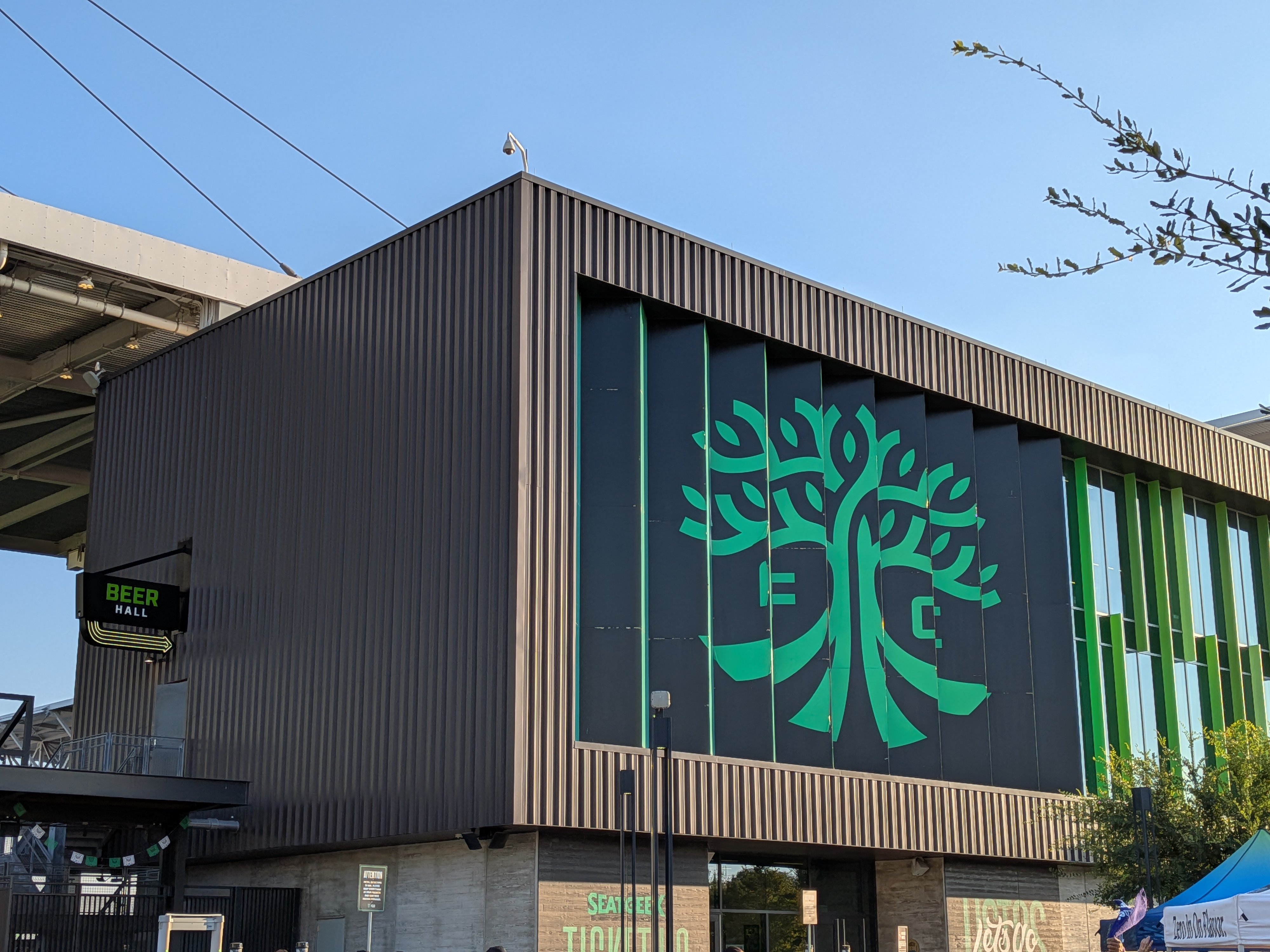
Walking around the concourse, you immediately notice that this facility is undeniably the home of Austin FC. There are murals and logos throughout that indicate it is a soccer-specific stadium built for the team. This stands in stark contrast to Snapdragon Stadium, where San Diego State University branding is visible everywhere, making it feel less like a dedicated home for San Diego FC. Even the supporters’ section seating at Q2 features “ATX” lettering across the stands. I will keep banging the drum that San Diego FC needs its own soccer-specific stadium regardless of location. Q2 Stadium is situated ten miles away from downtown Austin, which might not seem like an ideal location, but people will consistently show up to support a true home venue, just as 20,000 fans did on Saturday night. If you build it in San Diego, the people will come. However, please include a beer hall with plenty of local selections like they have at Q2, which was a fantastic feature of the stadium.

As the match kicked off, you might have noticed that actor and club investor Matthew McConaughey was in attendance to watch. The first half belonged entirely to Austin FC, as they recorded seven shots and nine touches inside the opposition’s box. Meanwhile, San Diego produced nothing of value, generating zero shots and zero touches in the opposition’s box. San Diego could not establish momentum on the wings, controlling most of their possession on either flank while generating a meager 18 percent centrally. On the left side, young David Vazquez appeared unable to handle, outmaneuver, or outrun 31-year-old veteran Mikkel Desler. The attacking runs on the right side looked similarly disjointed. The 3-4-3 formation carried over from the previous week worked reasonably well defensively in the first half, yielding 14 clearances for San Diego. However, when it came to completing passes to forward players in the final third, the system failed entirely, resulting in only nine accurate long balls with a completion rate of 39 percent.
Tactical adjustments were made at halftime as David Vazquez was subbed off for Cédric Bakambu. This move required Marcus Ingvartsen to shift over to the left wing while Bakambu took over at striker. The decision was impactful, making SDFC look like a brand-new team. Shortly after the restart, Anders Dreyer generated SDFC’s first shot on target in the 47th minute, which was saved. Marcus Ingvartsen followed with a saved shot in the 50th minute, and just seconds later, SDFC struck for their first goal of the night. Following a goal kick from goalkeeper Damien Las, San Diego won possession at midfield. Aníbal Godoy recovered the ball and quickly dribbled toward the edge of the penalty area before passing out wide to Oscar Verhoeven. Verhoeven sent a cross into the box where both Bakambu and Ingvartsen were stationed. Ingvartsen got his head to the ball, directing it toward the far side, where Godoy arrived to convert the rebound into a wide-open net while Las was covering the near post. That marked Godoy’s first goal of the season and his second goal in his SDFC career.
San Diego FC was not done applying pressure on Austin, quickly mounting another attack just a few minutes later. After Bakambu was fouled, Manu Duah took a free kick in San Diego’s half, passing to Jeppe Tverskov, who then played the ball forward to Godoy. From midfield, Godoy sent a long pass out to Marcus Ingvartsen, who had to control the ball with a high kick while the goalkeeper advanced inside the penalty area to make a play. With the goalkeeper caught far off his line, Ingvartsen chipped the ball centrally toward Bakambu. Bakambu jumped to head the ball toward goal, but SDFC received an assist from Austin FC when Desler inadvertently headed the ball into his own net. Holding a 2-0 lead, San Diego felt confident about their chances of securing a victory.
For good measure, San Diego FC added a third goal. Following a throw-in, San Diego built out from the back and moved the ball out to Anders Dreyer in midfield. Dreyer played a forward pass to Kieran Sargeant on the far side. Once inside the penalty area, Sargeant attempted a central pass that was blocked and cleared by Austin FC out to the near side for a San Diego throw-in. Dreyer rushed over to take the throw-in quickly to Sargeant, received the return pass, dribbled toward the penalty area, and laid the ball off to Bakambu. Bakambu quickly returned the pass to Dreyer as he drove deeper toward goal. Dreyer then passed centrally into the six-yard box to Marcus Ingvartsen, who redirected the ball into the back of the net. That was Ingvartsen’s 12th goal of the season, while Dreyer recorded his 11th assist and seventh goal contribution over his last six matches, stretching the lead to 3-0.
Following the third goal, Austin FC made strategic substitutions, bringing on Ilie Sánchez for Oleksandr Svatok and Jorge Alastuey for Besard Šabović. It took only a few minutes for Austin to regroup and unleash an attacking onslaught. The first goal originated when Jeppe Tverskov tried chipping a ball over a defender, only to turn it over in his own defensive third. Austin passed the ball around and sent an initial cross into the box that was repelled but recovered by Austin FC. Rebuilding the attack from the far side, Austin shifted play freely back to the near side, where Ervin Torres delivered a cross inside the penalty area that was headed home by Chula Vista native Brandon Vazquez. That was Vazquez’s first goal of the season. On the play, Vazquez pulled Ian Pilcher’s arm to create better scoring positioning, leaving ample space centrally to head the ball in. This was not the first time Vazquez beat Pilcher for a goal in Austin, having previously used his speed to beat him in San Diego and Austin’s first matchup last season; this time, Vazquez used his physicality.

Austin’s second goal arrived in the 82nd minute following a buildup from their goalkeeper into the final third. As the ball was worked around the near side of the penalty area, a pass from Ervin Torres to an unmarked Mikkel Desler opened up the defense. Desler delivered a cross from near the corner flag beyond the six-yard box, where Jon Bell incomingly redirected the ball back toward the center for Cristian Ramírez to head home. Kieran Sargeant appeared responsible for tracking Desler out wide toward the corner when Ingvartsen should have marked Torres, while Bell was left completely open on the back end. Austin operated with total freedom on the sequence as SDFC passively watched the play unfold.

Austin FC scored their third goal just a few minutes later, once again building out from their defensive third into midfield with ease. Austin played a ball over the top of San Diego’s mid-block to Jon Gallagher. Before Gallagher received the pass, Ian Pilcher was caught in two minds between stepping up to challenge for the ball or containing the space behind him. Pilcher accomplished neither, allowing Gallagher to receive the pass, cut in front of him, and slide a through ball to an unmarked Cristian Ramírez entering the penalty area. Ramírez slotted a soft shot inside the far post and into the back of the net while Duran Ferree stood frozen. The match was tied 3-3 with less than five minutes remaining in regulation.

In the final minutes, San Diego FC looked poised to score and claim all three points. San Diego reverted to their 4-3-3 formation and sustained possession in Austin’s half, generating seven shots during stoppage time, though none found the back of the net. Ultimately, the match ended in a 3-3 draw. For Austin, mounting a three-goal comeback to earn a point at home felt like a huge victory. For San Diego, dropping two points late in the match felt like a massive loss. San Diego has now dropped 12 points after the 75th minute this season and holds a -9 point differential from winning or losing positions late in games, tying them with the Chicago Fire for worst in the league. Another concerning metric is that the team only seems to win when keeping a clean sheet, as seven of their eight victories this season have been shutouts.
San Diego possesses a distinct identity focused on maintaining possession and attacking, and they should never stray from that philosophy. At one point during their brief 3-0 lead, they shifted into a back five and played defensively, granting Austin 13 minutes of uninterrupted pressure to attack. San Diego only resumed shooting and attacking Austin once the match was tied, by which point it was too late. Compounding matters was the backline’s complete inability to stop Austin. The defensive line lacks strength and is filled with inexperience; Saturday’s lineup featured a 20-year-old goalkeeper playing behind Ian Murphy (who was acquired during the transfer window), 23-year-old Ian Pilcher, and 21-year-old Manu Duah. Chris McVey, their most senior center back, remained on the bench the entire night. I am unsure whether SDFC hesitated to deploy McVey due to the risk of accumulating a fifth yellow card—which carries a suspension or fine—or if another underlying issue exists. Regardless, San Diego requires greater leadership from its defensive unit. Recently, Matt Miazga was picked up by New York City FC after FC Cincinnati released him for salary cap reasons. Miazga would have been a valuable acquisition for San Diego, given that FC Cincinnati fans praised his leadership as team captain and 2023 MLS Defender of the Year. Of all the players who departed over the past year, Paddy McNair is likely the most missed. McNair won duels like the one on David Martínez at LAFC last year, and brought a resume to the squad. When it comes to center backs, I do not mind a player who acts aggressively on the pitch, gets in opponents’ faces, or holds teammates accountable to perform better. Former Tottenham player Cristian Romero fits that mold; although he is a constant threat to receive two yellow cards or a straight red, he knows how to defend exceptionally well and demonstrates leadership on and off the field, earning the captaincy at Tottenham and positioning himself to captain Argentina upon Lionel Messi’s international retirement. I do not see any player on San Diego’s backline who possesses those qualities. As for the goalkeeping position, experience is equally vital, and Ferree was unable to deliver the crucial save when it mattered most, unlike CJ Dos Santos, who made essential save after save against a tough Miami team.
San Diego is running out of time. With seven matches remaining, they will need to win almost every game to secure a playoff spot. SDFC now has 13 days before their next match against the New York Red Bulls, offering a two-week training block to get synchronized. This represents their final opportunity to do so, as there are no remaining international breaks, friendlies, or tournaments on the schedule. It all comes down to seven matches across October and November to accomplish the goal. Last season, San Diego earned 17 points over their final seven matches, which might just be enough to secure a postseason berth. Just like Texas barbecue, success here may ultimately require patience.
Outside of Soccer
Lastly, I want to share this information with anyone who would like to support someone in the SDFC family and community. Jerry Jimenez is the supporters’ liaison for SDFC, and he helps organize the various Frontera SD groups for the club. To me, it is always a pleasure to see Jerry at an away match and say hello whenever I get the chance. Recently, Jerry’s father passed away following a cancer diagnosis. Jerry, our thoughts are with you and your family. If you would like to help out the Jimenez family, please see their GoFundMe page. Thank you.
Leave a Reply