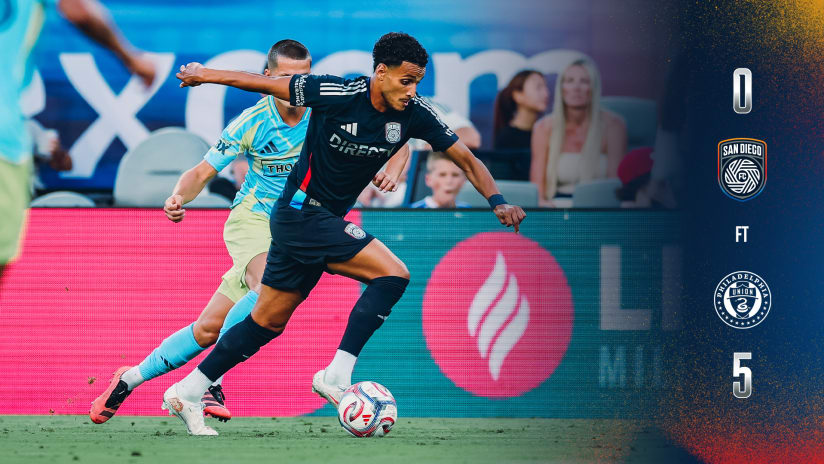
Collective sigh. It is time to talk about Sunday night’s match. It was a terrible match, and I’m not going to do any service in actually recapping the events—just a brief summary before taking a look at what may be causing the problems at San Diego FC. The lack of energy to talk about this match isn’t a one-time thing. At some point last season, I did a similar recap where I briefly summarized the goals and moved on to another topic, which I will do now.
Summary
- 1st Goal: After having a red card rescinded, the match had some extra stoppage time in the first half. In stoppage time, while Philadelphia was in transition, they were able to go end-to-end for the goal. After chesting the ball down, Jeppe Tverskov had to trail the runner going downfield, who was waiting for a pass in wide-open space on the near side. San Diego FC had the numbers going into the box, but they simply failed to mark their man. That left Cavan Sullivan central in the penalty box for a cheeky heel goal that narrowly went inside the far post. Everyone who ran into the box—Jeppe, Ian Murphy, Kieran Sargeant, and Onni Valakari—failed to do their job.
- 2nd Goal: The Union came out very direct at the start of the second half, trying to go vertical and stretch the field. At the hour mark, Mikey Varas subbed in Aníbal Godoy, David Vázquez, and Cédric Bakambu for Alejandro Alvarado, Onni Valakari, and Amahl Pellegrino. Right after those subs came on, the Union went the other way for a goal. This time, the Union were patient in their build-up; they passed the ball around in the final third, moving in and out of the penalty area. When the Union found space behind Oscar Verhoeven, they finally broke into the penalty area and Cavan Sullivan scored himself another goal. What made the goal so bad was that Anders Dreyer had containment of Sullivan on the far side, but Sullivan simply went around him after receiving a pass. Once Sullivan entered the box, someone else needed to pick him up, and clearly nobody did. Godoy was in the area close to Sullivan, but Godoy did nothing to defend him or intercept the pass going through. Everyone just reacted far too slowly. When the most dynamic player on the pitch is Sullivan, you have to be on high alert regarding where he is and where he is going.
- 3rd Goal: In transition once again, San Diego was on the move downfield. A long pass from Murphy to Sargeant on the near side was completed, but Sargeant quickly gave it away by kicking the ball straight to a Union player. The Union moved the other way with Sullivan on the ball, who sent a pass toward the near side to Francis Westfield, who was left completely unmarked. This created a 3-on-3 matchup with more SDFC players tracking back, but Westfield’s central pass was spot on. Murphy covered Westfield’s front side, so a pass to Milan Iloski—the player furthest up in the box—was not an option. Instead, the pass went behind Manu Duah and in front of Jeppe Tverskov to Bruno Damiani. Damiani shot and scored the third goal. Tverskov did nothing to close in and prevent the pass from reaching Damiani. Once again, the team was just too slow to react. Westfield only had two options, and the safest one was Damiani.
- Goals 4 and 5: These were an absolute joke. On a corner kick, it looked like Aníbal Godoy was trying to score on purpose, because what on earth was that? His header went straight into his own net for an own goal, catching everyone off guard—especially Duran Ferree. Maybe Godoy thought he could head it back so Ferree could catch it, but regardless, it was the worst possible outcome at that moment. The fifth goal was a late stoppage-time breakdown where everyone had simply given up. Quinn Sullivan received the ball at midfield, drove it all the way near the penalty area on the near side, and passed it centrally for Malik Jakupovic to score. Nobody did anything to stop it. Manu Duah was right in the path of the ball and did nothing.
San Diego FC had no answers for Philadelphia and their phenom Cavan Sullivan, who proved why he is the future of the USMNT and completely stole the show on Sunday night. San Diego needs to go back to the drawing board and turn this around quickly after losing their third straight match with just nine games remaining. Is there any hope things can get better? Maybe.
Front Line & Attack
Starting with the front line, Elias Achouri deserves a pass because he still needs time. I have compared Achouri to Denis Bouanga of LAFC before, and I’m going to do it again. In the half-season when Bouanga arrived late in 2022, he had just 1 goal in 7 matches. Achouri has 2 goals in 7 matches. He deserves a little more time to get acclimated. Do I expect 20 goals from Achouri next full season (2027–2028)? No, but I have a feeling he will get close to 20 goal contributions in a full campaign. During his first season at Copenhagen when he played regularly, he put up 18 goal contributions, and I believe that should be his floor over a full season in MLS.
As for Pellegrino playing the #9, he’s not a center forward. He has stated before that he’s not a number 9, so maybe management should stop playing him there. But SDFC is missing a true 9, and you just have to hope Marcus Ingvartsen can get healthy enough to finish off the season so we see him back on the pitch soon. When Ingvartsen features for SDFC in 2026, they are 7-6-8 (and all seven wins were clean sheets, by the way). Without him, SDFC are 1-0-3, with their only victory coming against the LA Galaxy. Going back to 2025, this team went 14-3-5 with the Ingvartsen/Iloski combo available, finishing the year 19-6-9 while going 5-3-4 without them. The system is heavily reliant on a true number 9. You just have to hope Ingvartsen gets back on his feet or that Bakambu can start matches soon.
As for Anders Dreyer, someone needs to remind him that he was an MVP finalist last year and needs to start playing like it. When Ingvartsen is out, Dreyer needs to be the guy taking shots—especially given his quality as a shooter and the fact that he is arguably the best finisher on the team. Instead, what we saw on Sunday was Dreyer attempting TWELVE crosses into the box. Who were you trying to set up with those crosses, Dreyer? There is nobody in the box worth crossing to right now, and that isn’t really San Diego’s style anyway. Only two of those crosses were successful, so he was actively hurting the team’s efficiency. Dreyer had more successful crosses than shots (he registered just one shot the entire match). This wasn’t even his season high for crosses—he attempted 14 against FC Cincinnati. I understand Dreyer is trying to be a team player and do what he thinks is best for the team, but it is frustrating to see the best player on the pitch for San Diego refuse to pull the trigger. We desperately need 2025 Dreyer to show up.
Midfield Concerns
The midfield is messy right now with Gabriel Pirani’s injury and an unknown timetable for his return. Pirani should be operating as the attacking midfielder who can be counted on for goals. Instead, the team has turned back to Valakari, who has been reliable and featured in every match last season. However, Valakari’s skill set is much better suited for an 8 role in a double pivot alongside Jeppe Tverskov rather than acting as a primary attacking midfielder.


The other option at the 8 is Aníbal Godoy. Side-by-side this season, Godoy posts higher marks in passing distribution—boasting a 92.7% pass completion rate compared to Valakari’s 87.2%—and he plays much more vertically with long balls into the final third. Defensively, however, Valakari wins far more tackles (61% to Godoy’s 48.1%), generates more ball recoveries, and wins more ground duels. That leaves them both looking average for the position overall. Valakari does have four goals and four assists, which makes me value him slightly higher than Godoy for that role.

Then there is veteran midfielder Jeppe Tverskov, who is having a down-ish year. His pass completion percentage remains steady near 89%, but oddly enough, his crosses have dropped to 11% of his passes (down from 35.7% last season). His long-ball accuracy has also plummeted to 50% from 64.6% last year. Defensively, Jeppe is clearly struggling; almost every statistical metric is down—interceptions, clearances, ball recoveries, and both ground and aerial duels per match. His overall duel success rate dropped from 64.0% to 58.4%. We don’t know how much his early-season injury is taking a toll, but he may just need rest rather than playing a full 90 minutes every match. At 33 years old, he simply cannot cover ground the way he used to.
The Defensive Line
To put it simply, the backline needs work. The options at fullback are struggling in a very demanding system. Oscar Verhoeven and Kieran Sargeant looked like they ran 100 miles on Sunday and were completely gassed by the final whistle. In this system, fullbacks are expected to push forward and overload the wings, but when possession turns over, they have to sprint back immediately to defend. Both players were doing that all match long—especially in the second half. By the fourth or fifth tracking sprint, mental fatigue sets in and you lose your man.
One center back who has remained solid is Manu Duah. In his second year, he continues to improve across almost every statistical category. Yes, he still has moments where he struggles in aerial duels, but he is currently the best center back on the roster. Pairing him with Ian Murphy has been fine, though it raises questions: Is Murphy genuinely outperforming Christopher McVey, or is management simply keeping McVey on the bench to prevent a yellow card accumulation suspension? It’s hard to say. Murphy only has a few hundred minutes with the squad and plays a very similar style to McVey, just without drawing as many cards.
Tactical Adjustments & The 3-4-3
So where do we go from here? There isn’t much flexibility for alternative tactics within the Right to Dream playbook, which limits what Mikey Varas can deploy, but a subtle formation shift could help—especially against counter-attacking teams that like to play long and vertical.
Since late last season, FC Nordsjælland has utilized a 3-4-3 shape. According to FBref data, Nordsjælland has only lost 3 of their last 23 matches when lined up in a 3-4-3. What would that look like for San Diego FC? We saw a version of it against Club América to disastrous results, but that match featured Ian Pilcher at center back. With all due respect to Pilcher, Ian Murphy is a clear upgrade with real league experience.
A revised 3-4-3 lineup could look like this:
- Backline: Ian Murphy, Manu Duah, Christopher McVey
- Midfield / Wingbacks: David Vázquez, Jeppe Tverskov, Onni Valakari, Dagur Dan Thórhallsson (Thórhallsson slotting in as a wingback makes sense given his comfort level moving into midfield)
- Front Line: Elias Achouri, Cédric Bakambu (or Ingvartsen if healthy), Anders Dreyer
Could this setup work? Possibly, and it puts the best available talent on the pitch. The current fullbacks are getting exposed and run into the ground trying to cover the entire flank. Adding a third central defender provides better defensive cover behind the wingbacks when pushing numbers forward.
Evaluating Mikey Varas & Ownership’s Vision
There is a lot of misguided anger being directed at head coach Mikey Varas. He has the tough assignment of balancing a roster packed with inexperienced pieces while trying to push for a playoff spot. San Diego currently has 14 players on the roster aged 25 or younger, most with very little top-flight experience (Gabriel Pirani being the lone experienced player in that young demographic). That means nearly half of the 30-man roster is dedicated to developing youth. Meanwhile, Ema Boateng hasn’t played a single minute while occupying a roster spot, and Bryce Duke was transferred to Australia after appearing in just 5 matches.
The squad lacks experienced depth, meaning the core veterans have to play heavy minutes or risk handing responsibility to unproven replacements.
It is easy to point fingers and call for the firing of Varas or Sporting Director Tyler Heaps, but the broader reality is that the Right to Dream ownership group wants the club run this way. They want a balanced model built on young talent mixed with selective veterans. That model comes with significant growing pains that fans are rarely patient with. In Year 1, Varas navigated those parameters smoothly; this season has been far bumpier.
As a Tottenham fan, I know all too well that not every season goes according to script. Managers can only do so much—the players have to execute on the pitch. Upgrading depth months ago in midfield and at fullback could have altered the trajectory of this season, but Varas and Heaps operate within the parameters set by ownership. Ownership wants the RTD philosophy implemented in San Diego, and that philosophy is what is frustrating parts of the fan base: trading away fan favorites, avoiding high-profile signings, and running the club differently than standard MLS franchises.
It reminds me of my previous work analyzing data for a brewery. When I ran the numbers and suggested to ownership, “Hey, maybe we should brew more Hazy IPAs,” they responded, “No, that’s not what we do; we stick to our core lineup.” I couldn’t force the head brewers to make Hazy IPAs without ownership approval.
Varas and Heaps aren’t going anywhere anytime soon because part of their job is to serve as a human shield when results dip while the system gets established. Every manager answers to someone. I am willing to give the RTD blueprint a few years to see how it matures, whether that is with or without Mikey and Tyler. I have the patience to see it through, and hopefully other fans will too.
This loss to Philadelphia should serve as a reality check regarding San Diego FC’s long-term goal: they want to develop their own Cavan Sullivans through the academy. Mikey and Tyler have already proved the concept works with Luca Bombino, who developed quickly, contributed on the field, and was sold for a significant profit. Ideally, we will see more players like Bombino break through the San Diego system soon and help build a sustainable contender.
Leave a Reply