
San Diego will face off against another LA rival on Saturday night. This is the first time the teams are facing each other this season, with the second matchup slated for October. Both teams are currently in 11th and 12th place in the Western Conference, with San Diego FC sitting at 27 points and the Galaxy at 26 points. This is a big matchup for both clubs and marks the return of Chucky Lozano. Whether you like Lozano or not, this match will draw a big crowd , making this a good time to review some attendance numbers before diving into the preview.
Attendance & Ticket Prices
A lot has been said on social media and by fans at matches regarding attendance, as people have been noticing a lot of empty seats. The decision to not play Lozano and eventually send him to the Galaxy on loan created division in the fan base, which in turn may have led to the dip in attendance. Data from fbref.com shows that San Diego total attendance through 11 home matches was 313,640 last season, compared to 260,014 through 11 home matches in 2026. That represents a 17.1% dip from the previous season. On average, San Diego is seeing 4,875 more empty seats than the year before, with an average attendance of 23,638. Even so, that average attendance number would still place San Diego in the top 10 in the league.
Is the lack of star power really the issue, or could ticket prices simply be too high? Ticket prices are another common complaint online. A review of each MLS team website on Thursday afternoon to find the cheapest single ticket in a non-supporters section for Matchday 23—just as any casual fan would do—revealed a wide range. The cheapest ticket for a DC United match was $72.60. The second highest was San Diego FC at $58.70, while the cheapest overall ticket found was in Nashville at $24.10. The average price across all 15 matches that week was $39.87. With no other California teams playing that week, checking the next home match for each California team showed San Jose at $42.48 against Houston, the Galaxy at $31.38 against New England, and LAFC at $45.98 against the Red Bulls. Averaging those three California figures yields $39.95, which is close to the league average for cheap tickets. The difference between San Diego’s cheapest ticket this weekend and the California average was $18.75, which would cost an additional $75.00 for a family of four.

The perception of empty seats is also influenced by playing in one of the highest-capacity stadiums in the league. San Diego’s Snapdragon Stadium has a capacity of 35,000, ranking in the top 5 in MLS. Leading the league is BMO Field in Toronto at 45,000. Second is the Mercedes-Benz Stadium at 42,500 for MLS matches, though it can fit up to 71,000 for the NFL. The other two stadiums ahead of San Diego are also NFL venues: Bank of America Stadium (Charlotte FC) and Lumen Field (Seattle Sounders), both of which reduce their capacity for MLS games. Across all 30 teams, the average capacity in MLS is around 25,286, with average league attendance sitting around 22,000. A stadium that holds 20,000 to 25,000 is likely the sweet spot for this league. The club should give serious consideration to finding a long-term stadium solution in the city or county of San Diego. Having a stadium that seats around 28,000 could work well moving forward for both San Diego FC and the San Diego Wave. How they accomplish that is anyone’s guess, but it will take a long time to reach a point where league attendance averages 30,000 to 33,000. MLS is growing in this country, but it is doubtful it can grow that quickly in just a matter of years.
For right now, a lack of star players and high ticket prices may be what is causing more empty seats at Snapdragon Stadium this season. Furthermore, San Diego FC started off slow in the first half of the season, though they have been improving since the World Cup break. Attendance for the recent Colorado match was not bad and was actually close to last season’s numbers against the Rapids. Last season, Snapdragon’s attendance for Colorado was 22,361, compared to 21,697 this year—a drop-off of just a few hundred people, or almost 3%. The LA Galaxy will also draw a crowd on Saturday night, so attendance may improve closer to the end of the season as San Diego FC fights for playoff contention. What fans would like to see for next season and beyond is ticket prices moving closer to the league average. There will likely be a market correction for the club, hopefully sooner rather than later.
LA Galaxy Preview
Looking at the LA Galaxy, while much of the talk surrounds Chucky Lozano, there is an entire team to discuss. Since the World Cup break, the Galaxy hold a 1-3-3 record and have been outscored 10-5. They have also lost the xG battle in all of those matches, making them fortunate to earn at least a point in four of their last five games. What San Diego will face on Saturday is the 25th-ranked scoring team in the league with 27 goals. However, the Galaxy rank 10th in xG at 32.86, proving to be one of the unluckiest clubs in MLS with an actual goals-minus-xG differential of -5.86. They take a high volume of quality shots on target, ranking 4th in the league with 114, but rank 27th in converting those shots, with a 9.64% conversion rate. They are a club that likes to counter, hit teams on the fast break, and play directly rather than building up. The Galaxy rank first in fast-break runs with 39 (resulting in 5 goals, ranking 7th) and third in direct attacks with 47 (resulting in 3 goals).
Defensively, the Galaxy have allowed 32 goals this season, which is the same amount as San Diego FC. The Galaxy have conceded the 8th-most shots at 289. Because they like to counterattack and fast-break, they leave themselves vulnerable to the same tactics, tied for third for the most fast-break goals allowed in the league with 7. Both the Galaxy and SDFC are top teams in ground duels, with the Galaxy leading the league at 52.9%. In terms of defensive actions, the Galaxy rank 9th in tackles (334), 7th in interceptions (210), and 9th in clearances (509).
The goalkeeping situation will be interesting for the Galaxy in this matchup. JT Marcinkowski holds the 5th-highest save percentage in the league with 60 saves and has prevented 5.8 goals (ranking 6th). However, Marcinkowski will be out on Saturday after receiving a red card in their previous match against CF Montreal. The next man up is Novak Micovic, who has played in 6 matches this season. Micovic’s most recent appearance was a 3-0 loss to LAFC in El Tráfico. Prior to that, he started against Sporting KC (a 1-2 loss), the Colorado Rapids (a 1-4 loss), Charlotte FC (a 3-0 win), and New York City FC (a 1-1 draw). Micovic started 20 league matches for the Galaxy last season and posted a 63.4% save percentage. This goalkeeping change represents a major shakeup for the Galaxy that San Diego needs to capitalize on.
Key Players
Turning to key players, Joseph Paintsil will play opposite Chucky Lozano. Paintsil enters Saturday’s match with 5 goals and 3 assists this season. In his three seasons with the Galaxy, he has accumulated 32 goals and 13 assists across all competitions. Among wingers this season, Paintsil ranks 7th in progressive carries (106) and 5th in progressive carries into the final third (70). His ability to drive into the final third makes him dangerous, but it also leads to turnovers; he has 62 final-third turnovers, which ranks 7th-highest among wingers. Paintsil actively seeks out one-on-one matchups, ranking 6th among wingers with 43 final-third take-ons. He leads all wingers in danger-zone entries with 48 touches inside the penalty area and ranks third in non-penalty xG with 7.35. When the Galaxy fast-break, Paintsil is usually waiting on the receiving end of a long pass to carry the ball into the attack, so containing him with the backline will be key for San Diego.
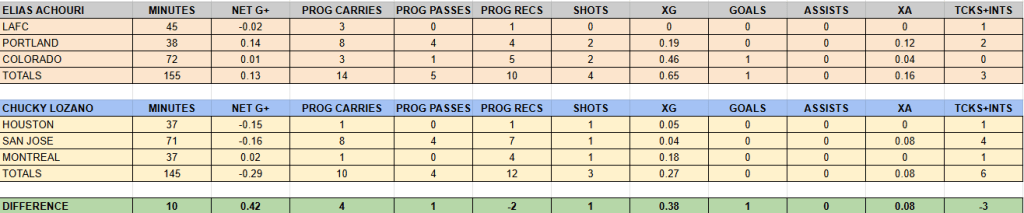
Finally, a player comparison between two attackers who have each played only three matches highlights some interesting early trends. In his three matches, Chucky Lozano has logged around 145 minutes, a net Goals Added of -0.29, 10 progressive carries, 4 progressive passes, 12 progressive receptions, 3 shots, an xG of 0.27, 0 goals, 0 assists, and an xA of 0.08. By comparison, Elias Achouri has played around 155 minutes, with a net Goals Added of 0.13, 14 progressive carries, 5 progressive passes, 10 progressive receptions, 4 shots on goal, an xG of 0.65, 1 goal, 0 assists, and an xA of 0.16. Important context for Lozano’s numbers is that his team has received three straight red cards across those three matches, forcing them to play a man down and requiring Lozano to create more on his own. Meanwhile, Achouri looks to bring quality to the left-wing position that is equal to or better than Lozano’s, showing great dribbling and playmaking ability early on. While it remains a small sample size, San Diego will hope Achouri’s strong form continues.
Leave a Reply