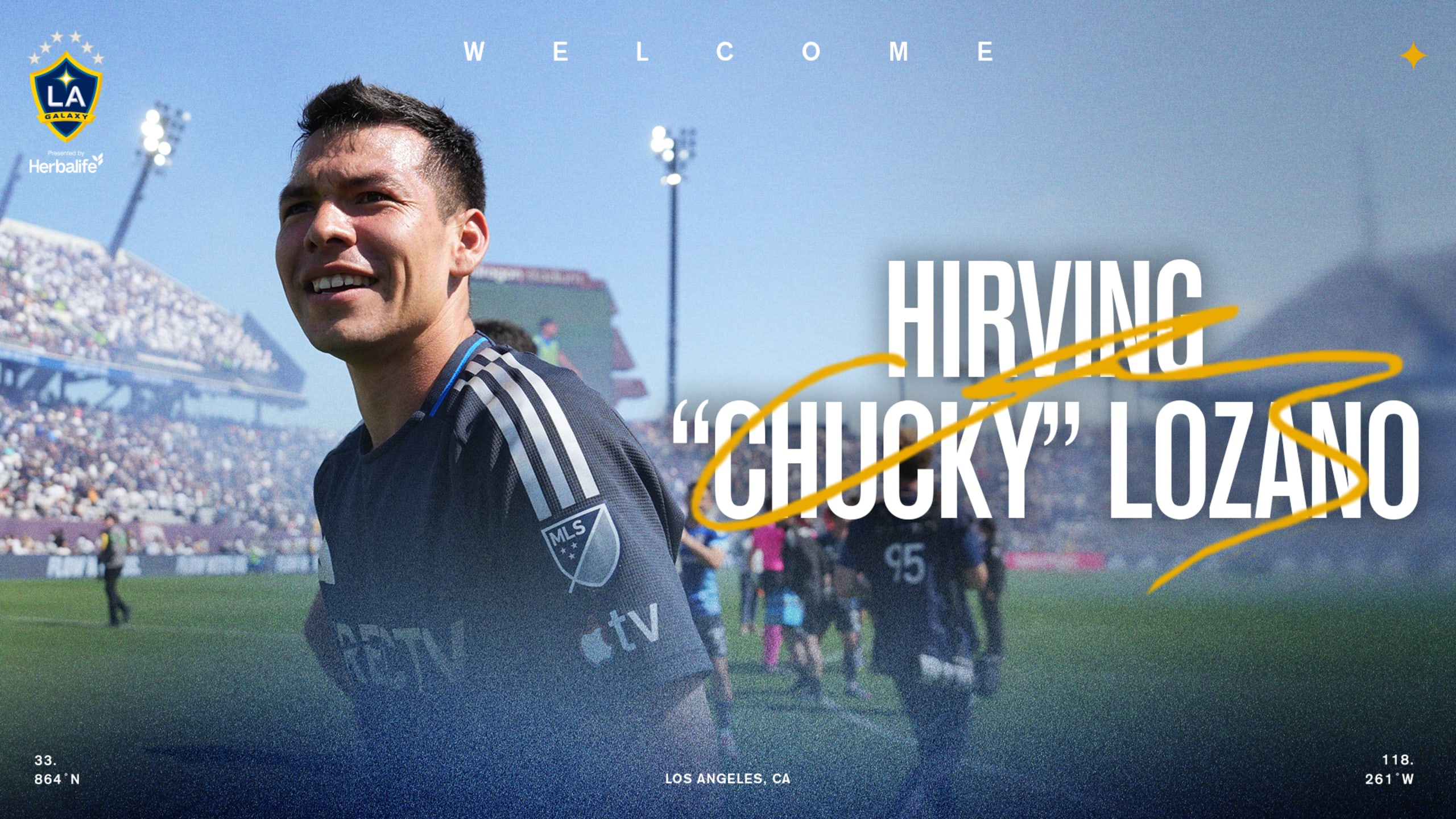
So let’s talk about Chucky (hopefully for the final time as a San Diego FC player).
On Friday, San Diego FC made the official announcement that Hirving “Chucky” Lozano is joining the LA Galaxy on loan for the duration of the 2026 season, with a permanent trade option at its conclusion. It was on Monday that Tom Bogert broke the news that Lozano was in talks with the Galaxy regarding a potential loan. Bogert, speaking on the Soccerwise Podcast, further explained that the deal involves the Galaxy paying less than half of Lozano’s salary for the remainder of the season, with San Diego buying down the budget charge so he can fit under the Galaxy’s salary cap and roster construction.
San Diego has wanted to move Lozano since the start of the season, when Tyler Heaps announced that he was no longer part of the team’s plans. Heaps explained that a permanent transfer was the best option, as they were not looking to loan him. Following that announcement, little progress was made toward moving on from Lozano, even as he continued showing up for side training sessions without being involved with the squad. When the summer transfer window opened, Heaps made it clear that he was still seeking suitors for Lozano, but emphasized that it would ultimately be up to Lozano whether he ever wanted to play soccer again. That brings us to Friday, when San Diego FC and the LA Galaxy officially announced the loan deal.
This loan is unprecedented. Designated players have been loaned out to other leagues before—much like the first designated player, David Beckham, who was loaned to AC Milan and PSG after joining the LA Galaxy. However, there has never been an interleague loan of a designated player. While trades have occurred, a transaction like this is entirely new. Trust me, I tried searching Google for one and couldn’t find a single example.
What does this mean for San Diego? Gathering what everyone has said on the topic, San Diego opened up a designated player spot, yet they cannot use it due to the risk of Lozano returning from loan if things do not work out with the Galaxy. Furthermore, because the budget charge was bought down, a portion of Lozano’s charge remains on SDFC’s books.
As for the Galaxy, let’s dive into the first domino that had to fall. With no GAM available to expand their roster, the Galaxy had to secure a deal that would help them during the summer window. That move was selling Gabriel Pec to Brazilian club Cruzeiro for $12 million. MLS clubs can convert a maximum of $3 million from transfers and cash trades per season into GAM. Since then, the Galaxy have been operating on a budget due to their limited resources.
The Galaxy first signed forward Robert Taylor as a free agent through the end of the season, with an option to extend through 2027. Next, they acquired Kyogo Furuhashi on a free transfer from Birmingham City on a contract running through the 2030–2031 season. That detail is important because the Galaxy added extra years to Furuhashi’s contract specifically to lower his average annual value (AAV) and ease his budget charge against the cap. Following that came the acquisition of Lozano on loan with minimal impact on their cap space. Today, the Galaxy announced the signing of midfielder Sergi Roberto as a free agent. These are not big-name or big-money transfers; the Galaxy are simply remaining budget-conscious until they acquire enough GAM to make larger moves or clear off big contracts.
Is there a strong possibility that the Galaxy pick up the option for a permanent transfer at the end of the season? According to Arman Kafai, who closely tracks the league’s GAM on his GAM Is Fun website, the Galaxy are currently in the negative for 2027 GAM—negative $935k, to be precise. The Galaxy will have to make roster adjustments to either trade for more GAM or clear off high budget charges hitting their cap.
As of today, it is difficult to predict what kind of player the Galaxy are getting in Lozano. He has not played a match since the Western Conference Final in November 2025. Lozano logged 9 goals and 8 assists for San Diego FC in 2025, but played in only 27 out of 34 matches due to injuries and international duty. Meanwhile, the Galaxy sit in 12th place in the conference with a -5 goal differential. Having played just one more match than San Diego, they have only 15 matches left on the season, including two fixtures against San Diego.
Through their recent acquisitions, the Galaxy have been attempting to bolster an attack that currently ranks 22nd in total goals, despite ranking 8th in expected goals (xG) with 29.34. Their differential between actual goals and expected goals is the second-worst in MLS. As of this writing, Gabriel Pec was second on the Galaxy in goal contributions with 9 this season. Since the World Cup break, the Galaxy are 0-2-2, having scored only 2 goals while conceding 7. This is a team desperately seeking production from anywhere they can find it.
Returning to Lozano and San Diego, it simply was not a good fit. San Diego is attempting to implement a system built not only on possession in attack, but also on demanding that attacking players contribute defensively—and Lozano just did not fit that model. That assessment does not just come from me or the team; it has been echoed by analysts from reputable publications like ESPN. As Eric Gomez noted alongside Darren Smith on Section 1904:
“Chucky is not defending. He is not involved in creating offensive play. He was a finisher, a guy who would stretch out the field. Several times during that 2025 season, I saw him just standing around, walking around, not being involved with the flow of play, and not engaging with his teammates to try to generate offense from the middle of the field.”
In this system and style of play, everyone must be fully involved. It is easy for fans to say he is an attacking player and ask who cares if he does not defend or help create from the midfield. However, his teammates care, the coaching staff cares, and ownership cares. The Right to Dream system is being implemented by the coaching staff and driven directly by ownership, who want every player taught the same way. It does not matter if you are the last player on the roster or the star player; you must play the Right to Dream style if you want to play in San Diego and beyond.
Will Lozano be the last star player or the last player from Mexico? Perhaps. It is not that this organization refuses to pay for top talent; San Diego already maintains a top-10 payroll, which might move closer to the top 5 when salary figures are released in the fall. SDFC CEO Tom Penn knows as well as anyone that success in this league comes from stocking your roster with talent. Penn achieved great success with LAFC and is trying to replicate that model in San Diego.
However, there are non-negotiable prerequisites for any player coming to San Diego. First, can you play the Right to Dream style? Second, can you serve as an example for younger players in the pipeline? This explains why they target the specific profile of players they do. Can your defenders not only defend but also move the ball forward? Can your midfielders play box-to-box? Can your front three create in the midfield and track back defensively when needed?
Elias Achouri was targeted and signed by SDFC over the summer precisely because of his familiarity with the Danish Superliga and FC Nordsjælland. This serves as a clear reminder of who is running things: ownership brought this philosophy to San Diego’s newest MLS club, and Mikey Varas and Tyler Heaps are here to execute it. If they ever feel a Mexican player fits that specific system, they will certainly pursue them, but until then, I would not hold my breath for a marquee signing.
What can San Diego do in the interim? Lozano is loaned out through the end of 2026, but nothing prevents them from bringing in a Designated Player on loan or utilizing one of their U-22 spots. Signings are still possible before the summer transfer window deadline on September 2nd. Securing a player on loan for a few months will be challenging, as other leagues are starting their seasons in a couple of weeks.
If this team is truly committed to the Right to Dream system, why not request a loan for a top player like Prince Amoako Junior through the end of the MLS season to showcase this style of play? Junior could play left wing while Achouri operates in the midfield. SDFC needs to make a move to prove that the Right to Dream system can succeed in MLS. They have to win back the fans, just as they did when they initially signed Lozano. It will be a steep task, but Heaps and Varas face the tough challenge of executing a successful season, proving this system can win, and reaching the playoffs—because for fans, winning cures all. Let’s just hope it is not too late to win those fans back.
Another step San Diego FC can take is offering an olive branch by making tickets cheaper, because this is not the product fans were originally sold. A noticeable portion of the fan base likely bought season tickets under the assumption they would be watching a star Mexican international. While most fans will stay loyal to the club, supporters naturally want to see high-profile players worth watching.
This issue extends beyond San Diego; almost every team not named Inter Miami has a star player problem. Every fan base wants their club to maximize its three Designated Player slots on household names. That includes the Galaxy, who were positioned to sign former Manchester United star Casemiro before he ultimately joined Inter Miami, leaving Galaxy fans feeling burned before they picked up Lozano.
Furthermore, very few globally recognized players come to MLS. This season brought Robert Lewandowski and Antoine Griezmann, while last season saw Son Heung-Min, Rodrigo De Paul, and Thomas Müller. Many supporters expected Kevin De Bruyne and Mohamed Salah to head to MLS this summer, but that has not materialized. De Bruyne looks set to remain at Napoli, while Salah joined Turkish side Trabzonspor, as both players still wish to compete in Europe. Moving to MLS often comes with the realization that you are entering your final playing years in your 30s, and both De Bruyne and Salah feel they can compete in Europe for another year or two.
With their star now playing in Los Angeles, San Diego must face reality and do something for its fan base—namely, lowering ticket prices. If San Diego is trying to sell a style and system unfamiliar to most fans, lowering ticket prices for the foreseeable future is the right move.
Finally, the Chucky Wars have been ugly, pitting sections of the fan base against each other—those who simply wanted to watch a Mexican star versus those who are strictly about San Diego and the club. This is a team in only its second season of existence, yet some supporters are already calling to clean house. I still want to give this team a chance with everyone in their current positions; there is no need to bail on the season so early with 16 matches left. I want to see this project through to find out if the Right to Dream system can succeed here, or if it will fail to yield trophies just as it has at FC Nordsjælland. Time will tell.
By the way, to those calling for Mikey and Tyler to be fired: you are barking up the wrong tree. If you want someone to be upset with, look at ownership. From backing contract extensions for Mikey and Tyler, to approving Lozano’s loan, to introducing a system that did not suit Lozano in the first place, ownership has driven all of it. Expecting that firing Varas and Heaps would bring in experienced replacements misses the point—any successor would still have to adhere to the Right to Dream framework.
I am patient enough to let this play out and keep learning about Right to Dream. However, if this organization and ownership prioritize selling young players over winning trophies in the coming years, there will certainly be good reason to fly banners over Snapdragon. Today is not that day, and this is not that season. Patience is a virtue
For now, I am excited to see how the rest of the season plays out with the squad we have. It is quite easy to recognize the leadership group of this team, and it is undoubtedly the Danes. I feel like the team is in good hands with Jeppe Tverskov, Anders Dreyer, and Marcus Ingvartsen. These are the same guys who go on boys’ trips out to Monaco to watch an F1 race alongside Onni Valakari and Chris McVey. That is not something you see from most teams; while most teammates do not go on holiday together, these guys like each other so much that a trip across the world is worth it for them.
These are the players trying to help not only win matches, but also actively implement this system. Tverskov is the captain who has developed into one of the best central defensive midfielders in MLS. Meanwhile, I think nearly every fan was wrong about Marcus Ingvartsen, who already has 11 goals and is looking to add even more. As for Dreyer, he not only emerged as one of the best players in the league last year—earning serious MVP consideration all season long—but he also hasn’t fallen off when it comes to his goal contributions.
Beyond their performances on the pitch, they are deeply involved in the community, dining at local spots and organizing soccer camps for kids. They have truly embraced San Diego, and that alone makes the Danes worth getting behind. Who knows? Maybe we are leaning a little bit more toward “San DANEgo.”
Leave a Reply